How It Started

(NOTE:  I’m doing two entries today because I missed Saturday.)

I was six years old when my youngest brother was born.  I can’t remember how I reacted when the people who were babysitting me informed me that I had yet another brother, but they claim I walked into the back yard and kicked a post.  I have no memory of it.

I do, however, have a memory of when I first saw Brian.  He was in mother’s lap in the front seat of our old white Ford sedan.  This was in the days before car seats for babies.  He was wearing a little blue outfit and cap, and he was red and crying.  I was gone.  He was the coolest thing I ever, ever, ever saw.  I loved him from that moment on.  He was my baby brother, and I was ready to introduce him to all the great things in the world, especially the world of stories.

I learned to read early, really early.  My mother would read to me stories from The Child’s World, a collection of books with stories and poems.  I also had my own collection of little books from my babyhood.  One of them was titled “Are You My Mother?”  I saw it the other day, and so I know it was written by P.D. Eastman.  I paid no attention to such details when I was little, but (you know) now that I write, writers’ names mean something to me.

Anyway, when Brian was only a baby, I would hold him and read “Are You My Mother” to him.  It is one of those great stories, the kind that have the perfect arc of plot.  Kurt Vonnegut describes it as “a man falls in a hole.”  The baby bird falls from the nest.  It can’t fly back so it goes searching for its mother.  It encounters other things, a kitten, a hen, a dog, a cow, and (genius) a front-end loader that the chick calls  a “Snort.”  The Snort puts the baby bird back in his nest, and his mother flies up and he knows immediately that she is his mother.  It helps that she has a little hanky tied on her head.  So…Brian was the first person I ever read a story.  It was great.  And in our very readerly household, he read right back to us.  Even when he was little he could read big articles from Reader’s Digest at the kitchen table.  He had a perfect sense of what the family would like.  We still like to read to each other, though we don’t get to very often.

There’s a pleasure in reading.  I know that all sorts of folks out there like to read.  We just don’t read to each other much.  That should change, right? We should try and bring that to more people.  I don’t have “Are You My Mother?” anymore, but I DO have The Child’s World.  I think I’m going to look at it again this summer.

Here is a picture of me from the summer when Brian was born.  You will notice my uncanny resemblance to Tina Belcher.  More on that later.

Eva as Tina

Posted in Uncategorized | Leave a comment

Hard Advice

Just about anyone who has ever wanted to write has sought advice from an expert of one sort or another.  I certainly have.  I have been chasing this particular dragon since I was a kid, beginning the year I turned fourteen and tried to write a novel on an old Underwood manual my mother had cast off.  I managed a book just under twenty pages that was set in New York and involved a young woman choosing various outfits.  (This ill-advised attempt was never finished.) I began in earnest to pursue writing twenty-eight years ago.  By “in earnest” I mean I said it out loud.  I started taking classes.  I’ve studied with some really great writers, and I’ve read their work, and I’ve listened to their lectures, and I’ve gotten the standard advice.  I’ve gotten advice about scheduling protected writing times, advice about where to send material, advice about how to generate material. I’ve gotten advice about agents and publishers and programs.  I’ve paid some high prices for this advice, thousands and thousands of dollars, hours and hours of time, and one tiny broken heart.

In anticipation of A BOOKISH AFFAIR, I’ve been thinking about the best writing advice I’ve ever given or been given.  Aside from specific ideas about a particular sentence or character or setting or (even) plot, there is one piece of advice that rises above all others.  “If it doesn’t work, cut it out.”

Understand, this does not refer to simple errors–run-on sentences, misplaced commas, misspelled words.  This refers to whether something works or not.  The idea is, if something is working that’s where you concentrate your continued effort.  If your reader can understand it and engage with it, build on that.  If your reader doesn’t get it, doesn’t engage with it, doesn’t trust it, questions its legitimacy, it’s got to go. You cannot make what doesn’t work function.  If it doesn’t work, addressing it will just make the problem bigger, and the area where you have strength gets neglected and in some cases gets shouldered completely out of the piece.

Two things to note here.  First, you must be listening to YOUR reader.  Not every person is YOUR reader.  Your reader is a friend you trust and whose attention you covet.  Your reader is as smart (or smarter) than you with a good sense of humor and great taste.  Your reader loves good writing and learning new things.  You must find or imagine YOUR reader, and when you do, your work will begin to take its best and most pleasing shape, but only if you follow the hard advice, “If it doesn’t work, cut it out.”

Remember that story of Michelangelo?  He would go to the marble quarry and look at these huge blocks of white rock and see figures trapped inside.  When he sculpted, he just took off everything that didn’t look like what he saw.  It’s a simple concept, but profound.  There’s a sculpture he did that he didn’t finish and one of his students did.  A discerning eye can see where the master stopped.   The student’s figure is smaller and lovely, but not like his.  Not almost alive in appearance.  Michelangelo knew the hardest advice, and he followed it.  Aside from the mess that was his personal life, which may have lead to some of the least feminine women in the history of great art, he was devoted to the simple and profound idea of focusing on what works, not what doesn’t.  He built from strength to greater strength, and eventually his weaknesses lessened.  Look at the Pieta.  Really look at it, and you’ll see what I mean.


Posted in Uncategorized | Tagged , , , , , | 1 Comment

The Big Question

So…I started teaching professionally (officially) in 1985.  I was interviewed by Hector Madrid, the principal of Deming High at the time, and his assistant principal and activities director.  They were all three at a convention in Albuquerque, and I drove up there from Socorro for the interview.  I have not been as nervous since.

They offered me a teaching job in English, then two weeks before the school year started they called me up and said they were moving me to Math.  I remember the night before my first day.  I lay in bed thinking, “I can’t teach Math.  I don’t know enough Math to teach Math.”  The next day I gave my first lesson, and I was immediately reassured.  I didn’t know much, but those kids…they knew N-O-T-H-I-N-G!  I couldn’t help but teach them.  They seemed to be WITHOUT any knowledge.  It was great, teaching Math that first year.  I taught Algebra.  I can remember introducing certain concepts, and the students looked at me with blank expressions.  I would say, “Okay, I realize it doesn’t make sense right now, but just follow the steps, and it will eventually make sense.”  And, it did.  It’s a funny thing.  In early Math courses you can almost see the little idea “light bulb” turn on over a student’s head when she gets it.  It’s so satisfying for a teacher, that little, “ooohh, I get it.”

English doesn’t offer that little light bulb in the same way, not very often.  I remember once I read a story to one of my sophomore classes at Goddard.  It was a story with a surprise ending, and when I looked up at the end, one of the boys in the room lifted his head and his eyes were round and bright and full of knowing.  It was terrific.  It kept me going for the rest of that year, that one expression of utterly transfixed joy.

It’s been over thirty years now.  I’m thinking of taking the big “R.”  I’m not sixty yet, and I know there are people who think I’m considering this too early.  Maybe I am.  Still, it’s been a time since I’ve had one of those “WHOA” moments in class.  The closest has been some of the photography work we have done in yearbook.  Students love to discover how they can put a hat on a head or a man’s head on a woman’s body. Ah, the simple joys.

I used to try all sorts of wacky things to make my classes more interesting or challenging.  I would put all my imagination into some list of songs to try and teach poetry.  Often the students would scoff at my attempts.  It would break my heart.  I would cry with frustration after class.  Then, I stopped needing them to like my class, to like me, and things got simpler.  I began to see them learn and improve, and even the ones I didn’t think had it in them would still manage to do something pretty well.  It hasn’t been a bad way to spend my life.  I love attention, and in class I naturally get it.  I love conversation and surprise, and my job consists of having conversations with the most honest, surprising, silly, sly people in the world.  I can only think of a couple of jobs that would be better, and I know of none I could do better.  I was made of bossy, noisy, feisty material from the start.  I was cut in the shape of a teacher from age six.  When I was born I’ll bet the doctor thought, “Nerd alert.”

So…if I retire, will I die soon after?  That’s the big question.  This is what I like to consider when I think of retiring. I like to think of the breeze blowing through the pines outside my window.  I like to think of the sky.

blog-house-back

Posted in Uncategorized | Tagged , , , , , | 2 Comments

Bookish

A couple of years ago, I came up with an idea to put on a community party, of sorts.  I had been running a small publishing house of my own with only limited success, and I began to form a theory as to why. Very few people in the community were choosing to read authors from this area.  How can writers who work here, in the southeastern quadrant of a southwestern state get any support or traction if our community doesn’t support us?  Why don’t they support us?

My answer was, they simply don’t know us.  They haven’t had a chance to read our work.  Since that time, I have had the chance to try and share my own work, as well as the work of writers I have published and writers I admire.  It is not easy.  There is some element of, “If it’s from here, it must not be that good.”  That’s ridiculous.  Obviously artistry is not limited to urban locals.  Look at Peter Hurd’s paintings.  They are astonishing, beautiful.  Georgia O’Keefe was living and painting in New York with her husband, but when she came to New Mexico, that was it.  She moved her life and her work here.  Artists, writers, and poets are everywhere.  They reside in the heart of their vision, and that vision is not limited to an urban community.

On the other hand, the publishing center of the United States is New York, New York.  This has partly to do with its historic roots.  Many of the best publishing houses are there, and they have been there for more than a century.    Take Knopf.  I first heard the name specifically in college, but I knew their productions before that because I came from an erudite home.  The name of the company fills me with romantic rapture even now.  Their books bespeak excellence in both content and production.  They publish Pulitzer winners, National Book Award winners, Nobel Prize winners.  Why all that success?  Because they are good business people seeking to produce a superior product, and they groomed the reading and writing communities along the east coast.  Of course, they have the advantage now of a remarkable organization and a HUGE reading audience.  Writers PINE to get a letter from Knopf.  They should.

I would love to have some small portion of the cache of Knopf.  However, I live here.  I love this place.  I am never going to read a novel titled STANDARD DEVIATION by Katherine Heiny (though that sounds hilarious).  I prefer to read books that have some real interest FOR ME.  I prefer to read books that are linked to my life and my experience.  I prefer to read Barbara Patterson or Joyce McCollaum or Ralph Rivera or Hedda P. Saltz, not simply because they are people I know, but because their work is MORE RELEVANT to my life than Katherine Heiny’s.

Look, I have no problem with this Heiny woman, and I might read her book.  Who knows?  I just want to read books that make some sense to me as well.  And…I want book clubs to read the authors I publish.  They are amazing writers, and they will give readers great joy if only the readers will give them a chance.

Beverly Coots, another writer friend of mine, encouraged and worked to get another BOOKISH AFFAIR on this summer.  So…we’re having one on 23 and 24 June.  It will be great and fun and worth everyone’s trouble.  I hope folks will come.  Anybody out there who reads this, tell me what you think of the image we made for the event.  Isn’t she beautiful?

Bookish image with words

More tomorrow.

Posted in Uncategorized | Tagged , , , , , | 3 Comments

Blocked

So…I have never had writer’s block.  Can you hear my knuckled tapping wood?  What I have been is frustrated and over-obligated so that I could not keep up with this blog.  I have had all sorts of ideas about what I want to write here.

A few weeks ago I thought about telling the story of when I got a job as a welder to pay my way through college.  It seemed topical.  We were (are) going through some pretty stormy political times.  BUT, I hate politics.  Don’t get me wrong.  I appreciate those politicians who at least have the impulse to help others and the willingness to set through unending meetings about all sorts of esoterica and really important matters as well.

I considered writing about health care.  My recent journey with mother to the hospital had it ON MY MIND.  Oh, I have stories to tell about all sorts of folks in health care, but I’m not fully ready to share what I observed, and (worse) I have a feeling it is really important and funny and probably will not get any attention or perhaps way too much attention.

This time of year I always think about holding forth on matters of the church, but this year I dare not, not yet anyway.  There is a reason the framers went to such trouble to not have a state church, to keep politicians out of pulpits and preachers out of public houses.  I know these reasons because I read books, lots of books, and I have some things to say about this as well.  This too will have to wait.

On Christmas Eve, the birthday of my sister-in-law Carolyn, I drove out to Bitter Lakes, a bird sanctuary about ten miles outside of Roswell.  It was a gorgeous day and the birds were flying and honking and eating and doing all manner of bird things against an electric blue sky.  I thought of my dear friend Sue Coleman.  We once went to Bitter Lakes to shoot some photographs.  It was a grand time, and we only got in trouble once for straying down forbidden paths.  I thought back to other winter days when John and Mother and Carolyn and I watched the geese flock to Bitter Lakes for the night, their sound and glory stunning us with delight.  And still I traveled farther back into my memory, to a time when I was young and full of hope and went to the Bosque with Debra and Diane (Leslie may have been there, too), and we saw afar the great Whooping Crane, an unparalleled beauty even at great distances.

Before I begin holding forth on all the things that worry and anger me, I would like to hold forth on the beauty of the earth, on the glory of the skies.  Look up, friends, look up to the vault of heaven and see the blessings that are free to all and pristine.  See the infinite mercy of God, whose Son (in whom the hope of all resides) refused politics in service of the soul, and whose Spirit comforts me even now.

blog-soul

Posted in Uncategorized | Tagged , , , | 3 Comments

Mom’s Return

I can’t believe how many days it has been since I’m logged in to let folks know what’s happening at Casa McCollaum.  So…rather than go into the grim details, I will say that mother seems to be on a more even keel since her bout of dizziness earlier this month.  She had gotten dangerously low on electrolytes, and that had made her weak, confused, unsteady, and all her food had a strange metallic flavor.  Well, at least I learned the warning signs.

Years ago she went through a similar experience, but at that time, she had been sick with a bad cold.  Not so much, this time.

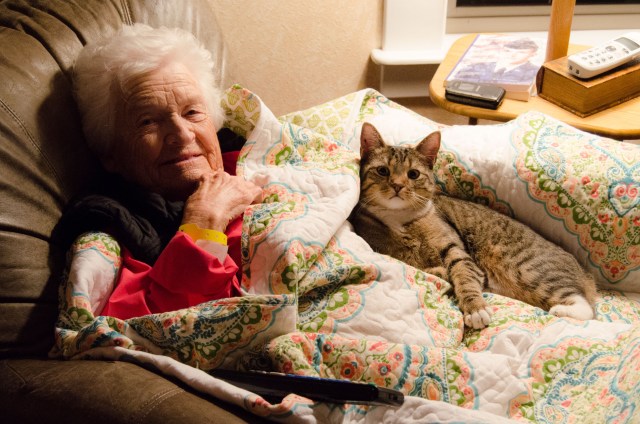
After a trip to the hospital and then home and then back to the hospital and a change in meds, and me almost losing it, thinking thoughts like, “You’re lucky I don’t punch people because you are prime candidate,” about a little prissy girl who couldn’t be bothered to help mother or me when we were in the emergency room, we finally got home.  We’ve now been home a week, a whole darn week.  I thought folks might like to see a picture of Mother with her little friend the day she got home, so here it is.

moms-best-friend

I am so deeply thankful to those of you who have visited and prayed and encouraged us both.  So many people in this little world in which we live are dear to me, and to Mother.  We hope all of you have a joyous Christmas season.  Remember, Jesus loves you, and so do I…even the folks who sometimes are the focus of my sinful wrath.

Posted in Uncategorized | 4 Comments

Two More

Today we add working thesis from my two remaining Seniors.  The first is examines way in which violence begets more violence.  The second explores how Heathcliff falls from remade man into mad monster.  Let’s hope the essays are as pleasing as the theses are promising.

“Emily Bronte uses mental and physical violence of each character in Wuthering Heights to show that every character portrays an inner evil because of the abuse and violence they endure.”

Andrew Kulikoff

“Although Heathcliff pursues justice by returning home to seek revenge, he takes it way too far and therefore becomes the monster himself.”

Jose Ochoa

I like reading this book.  I’ll like it even more when I con compare it to Jane Eyre.

Posted in Uncategorized | Leave a comment

Two in One Day

On 14 September 2015, two men were crowned American Ninja Warriors. The first was a man thirty-six years old, a camera man, a father, an athlete and a philosopher. The second was a mountain climber, a busboy, an athlete and a philosopher. It was an inspiring pleasure to watch them. Still, neither one of them is my favorite Ninja competitor. My favorites both failed that night of nights. One, Joe Moravsky, also known as the Weatherman, fell in stage three. My absolute favorite, a man named Brian Arnold, fell in stage two because he could not let go.

I will write a bit more about what I learned from Brian Arnold in a few. First, I want to reflect on losing. I’m frustrated right not with how I’m beginning to lose track of things.

I’ve been trying to recall a line from some play or movie or television show that goes something like, “I never liked that thing.” I’m sure the line ends with some other word than “thing.” Anyway, I’ve been wanting to recall the line and its source because of its context. In the context of the scene the line is a surprise. It’s a surprise because the item seems like something precious so when the character says, “I never liked it,” our perception of the character, the scene and the thing itself are transformed.

That power of words to change the scene or our ideas is what most interests me about writing. It’s not JUST an old worn cliché that words have a power beyond what we expect. Words encourage, frustrate, wound and comfort us. William Blake (I’m told) had a little quote on his wall. “Damn braces; bless relaxes.” That is we curse the things that limit and restrict us, and we bless the things that ease us. Yes, and even more subtle, when we say “damn,” our lips close in tension. When we say “bless” our lips open and relax. Words change us, inside and out.

I suspect the necessity of change can be most successfully ameliorated by words. We must change. We will change, and words are the most abundant tools we have to confront that change with joy.

I once asked my dear mother, “Why must we get weaker and uglier and suffer more pain as we age?”

She said, “So we can allow ourselves to let got of this life.”

I was feeling sorry for myself when I asked her the question. I am often feeling sorry for myself, and my mother offers me many an insightful word to teach me maturity. It is hard to let go of things, especially if your stubborn nature has brought you much farther than most people might have expected you to go. Letting go is hard because it requires faith, courage, and (let’s face it) a sense of adventure. “Terrible things could happen if I let go.”

“Yes, and wonderful things.”

“I could fail if I let go.”

“You’ll fail if you don’t.”

When I saw Brian Arnold fail to let go of a metal ring, I saw him struggle valiantly, not just with an obstacle course. I felt how the angels must when they see someone struggle to move forward and yet falter. I drew in my breath. If only he had let go, I thought. It is something to contemplate, as I contemplate my retirement, my health, my work. Don’t be afraid to let go, Eva. Don’t be afraid.

Posted in Uncategorized | Tagged , , , | 1 Comment

Wuthering Heights and the Working Thesis: It’s About Time!

How long has it been?  I’m ashamed of how little work I’ve done on my blog.  It has been months since I last wrote.  I actually have a backlog of ideas on my desk.  So be it.  We must begin again, and we will do so with my Seniors and their current working ideas about Wuthering Heights.

Robles:  “The complex notion of mad passion is realistically revealed in several characters of Wuthering Heights.”

Stokes:  “In Wuthering Heights Bronte offers characters who display madness and mania and create the environment to generate more of these psychological disorders.”  (Everyone is at fault.)

Hemesath:  “In Wuthering Heights Bronte reveals Heathcliff’s and Catherine’s relationship as a love poisoned by obsession and torment.”

Garcia:  “The different roles in society between Heathcliff and Catherine are the main factors that make their relationship disastrous.”

I am learning to love Wuthering Heights.  The first time I read it, I was too young to appreciate it.  The ferocious characters and their miserable rages were too dark for me to appreciate.  I failed to notice their honesty.  Maybe that’s not true.  I failed to appreciate their honesty.  I liked complicated characters, but I wanted them to be good, loving, without rage or sin.  I wanted the lovers to get together, and I never would have been able to appreciate a vision in which love was corrupted by selfishness.

Now I understand that it is only the exceptional love that is not tainted with selfishness,  the unique lover who does not fall into moody doubt and jealousy.  It’s academic, this exploration of love, academic in the best sense.  Reading Wuthering Heights and Jane Eyre is diving into scholarly discussion with two superior and vast minds engaged in a discussion about the most important things in all the world.

Tomorrow I will discuss American Ninja Warriors.

Posted in Uncategorized | 1 Comment

Happy Bastille Day

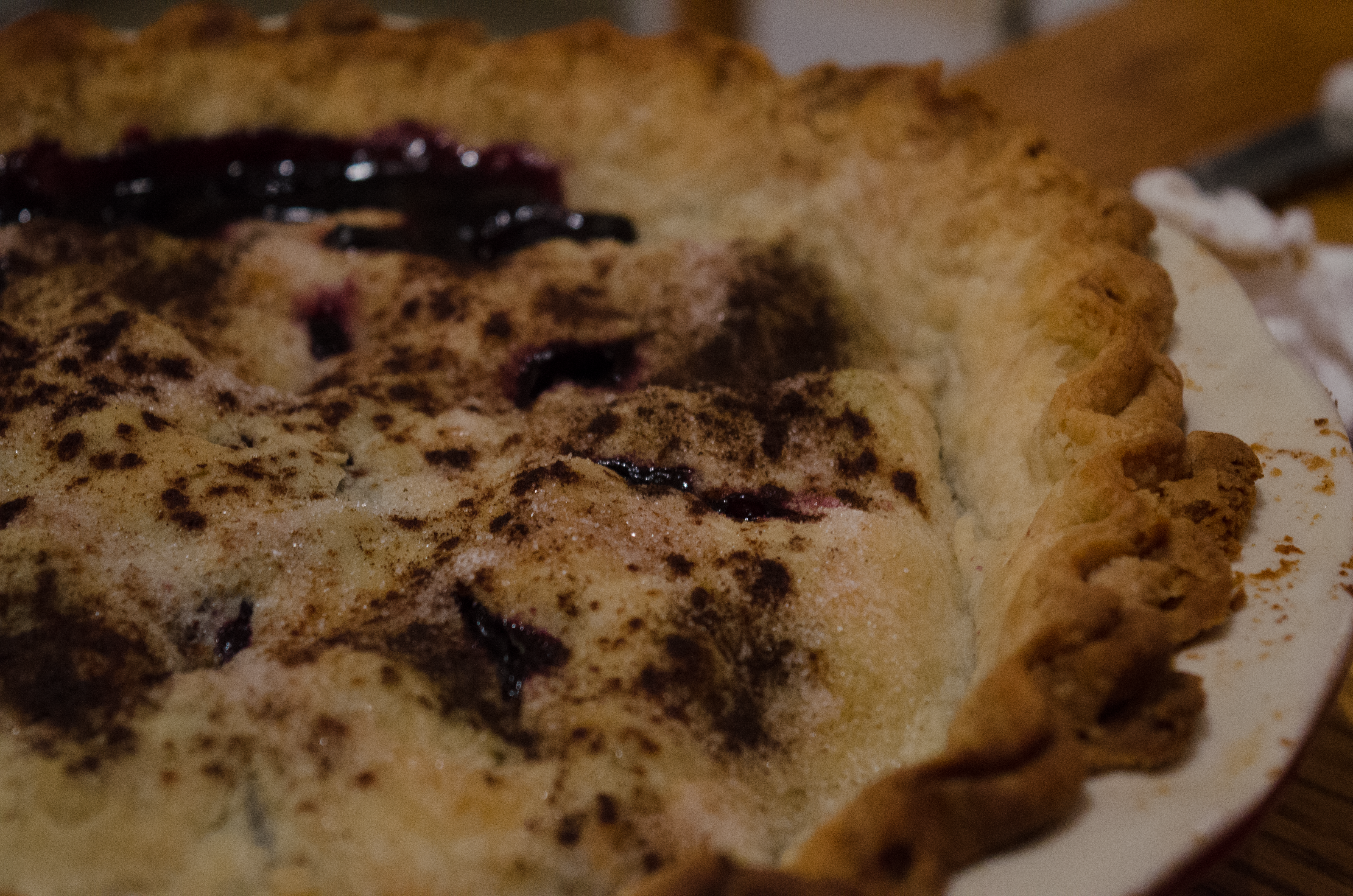
Today is my youngest brother’s birthday.  I wish I could be with him this day, but as I am a big stick-in-the-mud and he is the-life-of-nearly-every-party (excepting, of course, my other brothers in their turns), it is probably just as well that I am not with him. However, in honor of his special day, I have made a blueberry pie.

Blue berry pie

Now, let me make this clear.  This is a fine blueberry pie.  The crust is crisp, light, flaky, a delicate dream.  The filling is fragrant, sweet, and complicated, a little like eating something that tastes the way a cross between a rose and a carnation ought to taste if flowers tasted like they smelled–that kind of pretty.  Slice it while it is too hot to eat, while the filling is still bubbly, and spoon on vanilla ice-cream.  This borders on the erotic.

blueberry pie with ice cream

I can make a pie like this now, but it was not always so.   When I was younger, I could make many dishes.  I started making cookies when I was three, bread when I was eight, pasta at ten.  I knew what I loved, and I was willing to study spices  and flavoring in order to do more than many of the dishes valued in those days by my family.  I studied how my Grandma McCollaum worked, how my Grandma Jones worked, how my mother worked.  When I hit my twenties, I began arranging dinner parties, reading gourmet magazines.  Still, in all that time, I could not make a pie crust.

I tried. A LOT!  I tried, and it was terrible and then I would give up, make grilled duck with berry and cassis reductions.  One year my mother was out traveling the world during the holidays.  My brothers Brian and John were spending the holidays in Deming, and I was the main cook.  I decided to try again with the pie crust, to try and make a pumpkin pie.  The crust turned into something between hard tack and leather.  I L-O-S-T it.  I started crying, like a hysterical knit wit, like a toddler who had lost her binky, like a banshee.  My brothers came in and asked, in the kindest way possible…

“What the hell is wrong?  Have you burned yourself?”

Me:  I cannot do it.  I can’t.  There’s something wrong with me.  I’m pathetic. (I howl.)

Brothers:  What can’t you do?

Me:  I can’t make pie crust.

Brothers:  And that’s why you’re crying?

Me:  Isn’t that what I just said?  I cannot make pie crust.  I WANT TO DIE!

Brothers:  Because of pie crust?

Me:  You don’t understand.  Mother’s not here.  She can make pie crust.  I cannot.  What am I supposed to do?  How am I supposed to make a pie if I can’t make pie crust?

Brothers:  Why do you have to make a pie?

Me:  (Howling and indistinct words) Oh.

Brothers:  (Baffled but sympathetic)  It’s okay, Eva.  We don’t need pie.  Everything else will be great.  We won’t even have room for pie.

They finally got me calmed down, after half an hour of me ranting and tearing my clothes and rolling around on the kitchen floor.  John showed remarkable patience that day, especially for him.  He usually evinced little tolerance for my theatrics, but that day he was cool.  Brian, of course, was always cool, always supportive, especially of my cooking, and sympathetic and tolerant when I would storm and engage in deplorable self-loathing.  Brian was always there to talk me off the ledge and buck me up, and even (when he had to) tell me to cut the horse-shit.  “It’s enough already.  You know you’re better than this.”

That’s why I made a pie this very evening.  I wish to celebrate the day I got my third brother.  I thought I wanted a sister at the time, but I changed my mind the minute I saw him.  He’s been my baby bother ever since–my secret keeper, my battle buddy, my ally, my foil, my friend.

Cheers, Brian, and many happy returns.

Posted in Uncategorized | Tagged , , | 2 Comments